Prompt · 帖子正文
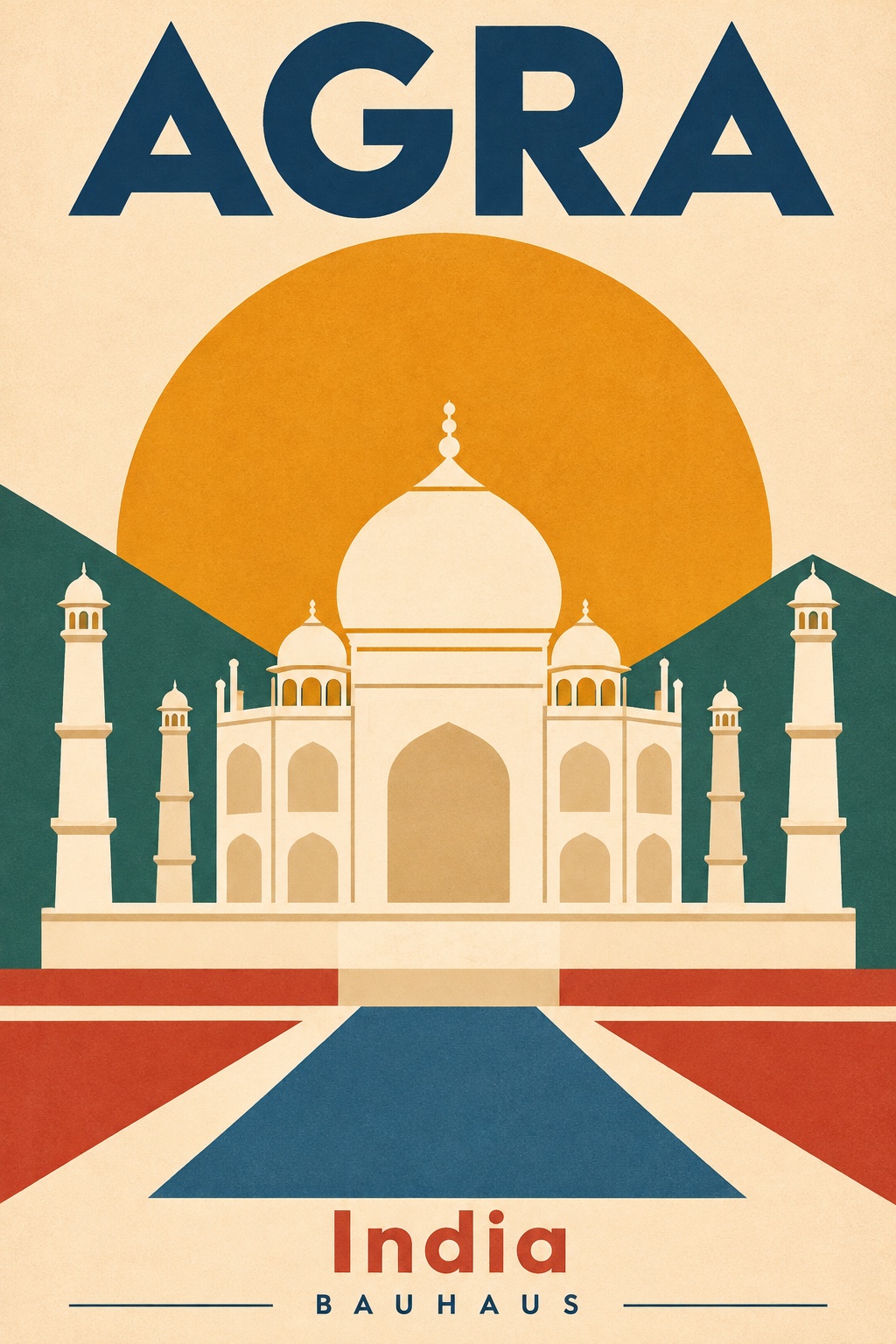
极简包豪斯几何旅行海报 · 泰姬陵
地标剪影简化成矩形、圆、三角等几何纸片,背后叠超大半圆当日月,每个目的地 4–6 色专属色板配暖象牙底,顶部超大几何无衬线城市名、底部小字国家和 BAUHAUS 标签,平涂无渐变
Prompt English
Create an exceptionally beautiful, ultra-minimalist Bauhaus-inspired architectural travel poster featuring the Taj Mahal, Agra, India.

1. ICONIC ARCHITECTURAL SILHOUETTE

Feature the destination’s most recognisable landmark as the central artistic subject.

Preserve its authentic architectural identity and instantly recognisable silhouette.
Simplify the structure into clean geometric lines, rectangles, circles, triangles and elegant architectural proportions.
Use minimal details to communicate the landmark’s character.
Make the architecture appear as though it has been constructed from carefully arranged geometric paper cutouts.
Avoid photorealism, excessive details and complicated textures.

2. GEOMETRIC ARTISTIC COMPOSITION

Build the entire poster around a striking arrangement of oversized geometric shapes.

Large semicircles and circles representing the sun or moon.
Bold rectangular architectural foundations.
Angular trapezoids and triangular landscape forms.
Layered geometric platforms supporting the landmark.
Carefully overlapping shapes creating depth.
Simple curved forms and architectural abstractions.

Use only shapes that complement the landmark’s natural structure.

3. UNIQUE DESTINATION-INSPIRED COLOURS

This is the most important part of the collection.

Create a completely different 4–6 colour palette for every destination.

Choose colours inspired by the destination’s architecture, history, cultural identity and natural surroundings.

Use bold primary or complementary colours, balanced with warm ivory or soft neutral backgrounds.

Never repeat the same colour combinations between destinations.

4. MINIMALIST GRAPHIC STYLE

Flat vector illustration.
Solid colour blocks.
Crisp architectural outlines.
Strong geometric contrast.
Subtle vintage paper texture.
Perfectly controlled negative space.
Clean, sophisticated modernist aesthetic.
No gradients unless absolutely necessary.
No unnecessary decorative elements.

5. TYPOGRAPHY AND LAYOUT

At the top, display the destination name in oversized, bold, uppercase geometric sans-serif typography.

AGRA

At the bottom, add a small artistic caption:

India

Include a discreet design movement label such as BAUHAUS.

Keep the typography exceptionally clean, balanced and beautifully spaced.

6. SIGNATURE ART DIRECTION

Inspired by original Bauhaus graphic design, Swiss modernism, mid-century travel advertising and minimalist architectural illustration.

The poster must look like a timeless collectible from an international design exhibition.

The composition should be instantly recognisable even from a distance.

Portrait 2:3 aspect ratio. Warm ivory background. No borders, no photographs, no people, no flowers, no leaves, no watermarks and no unnecessary text.
占位符
- [LANDMARK NAME]
- the Taj Mahal
- [DESTINATION NAME]
- AGRA
- [CITY]
- Agra
- [COUNTRY]
- India
来源说明
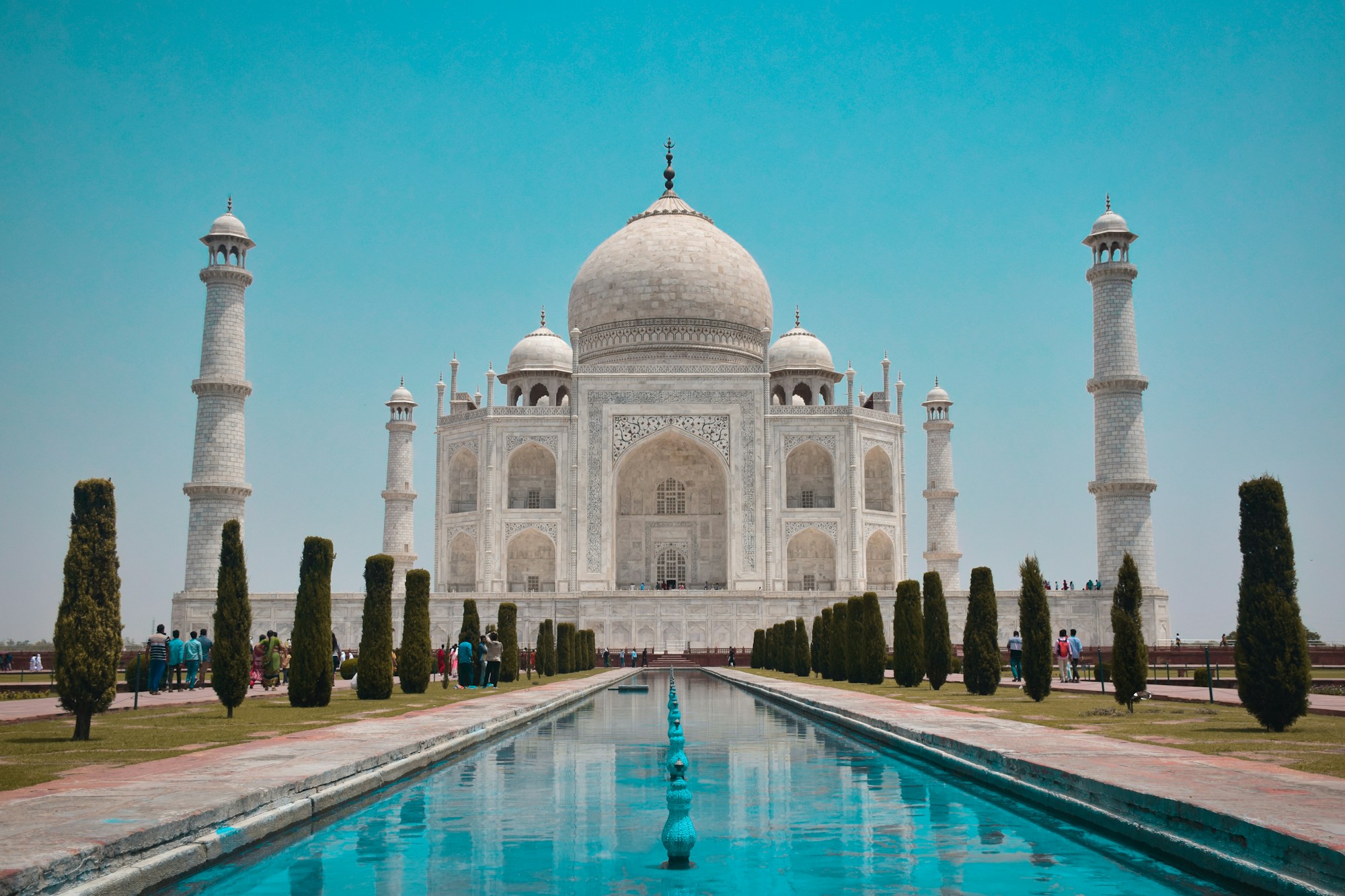
完整写在正文里,已去掉开头的模型名行「GPT image 2.6」和「Prompt:」引导语,其余逐字未改。这是模板 prompt:按上传的泰姬陵照片,[LANDMARK NAME] 填 the Taj Mahal、[CITY] 填 Agra、[DESTINATION NAME] 填 AGRA、[COUNTRY] 填 India;带占位符的模板原文保存在 prompt.templateText。原 prompt 是文生图且要求「no photographs」,这里照片只作为地标轮廓的参考图一起传给模型。